Three monographs exploring politics, philosophy and place in contemporary Britain and beyond.
Spinoza and the Politics of Freedom – now open access
Edinburgh University Press, 2021
Part of the Spinoza Studies series
Taking as its starting point the formative role of fear in Spinoza’s thought, this book argues that Spinoza’s vision of human freedom and power is realised socially and collectively. It offers a new critical study of the collectivist Spinoza, where we can become freer through desire, friendship, the imagination and transforming the social institutions that structure a given community.
Drawing on untranslated materials and bringing fresh perspectives to key debates, it repositions Spinoza as the central thinker of desire and freedom, demonstrating how his work informs contemporary discussions around democracy, the multitude, populism and power.
Taylor is indeed endowed with a real talent for narrating philosophy: he knows how to construct a narrative that reads with the ease of a novel without ever compromising the philosophical analysis. This is a rare ability that allows the reader to share with the author the obvious pleasure he took in writing his book, for this very reason destined to be well received by a much wider readership than that of “professional” Spinozists.
— Mogens Laerke
The great merit of Dan Taylor is to have returned to Spinoza’s conceptions of human servitude and the efficacy of the multitude as political actor, setting aside any notion that the work of the previous generation of scholars has somehow settled the conflicts that animate these conceptions in their textual existence. His book represents an extremely erudite and provocative reconsideration of some of the most important of Spinoza’s philosophical discoveries. He has opened up new paths in Spinoza scholarship.
— Professor Warren Montag
Key Features:
- Reconceives human freedom in Spinoza as intrinsically social and politically committed
- Combines careful historical analysis with contemporary political theory
- Draws on new textual findings from recent critical editions
Now open access – read here for free.
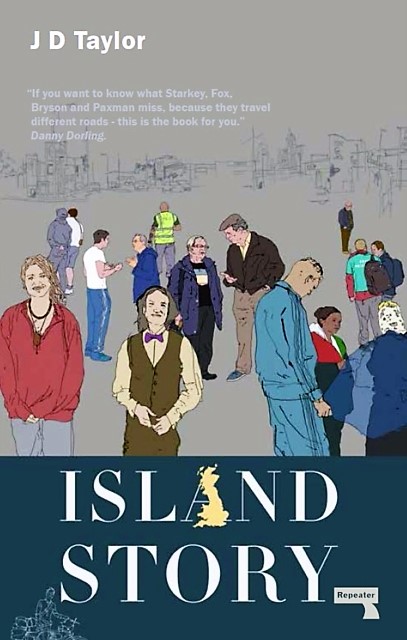
Island Story: Journeys Through Unfamiliar Britain
Repeater Books, 2016
Shortlisted for the Orwell Prize for Political Writing 2017
What is life like on this island? With a tent and a rusty bike, I set off to find out. Over four months in 2014, I cycled through the parts of Britain that have been written out of the story – post-industrial towns, forgotten seaside resorts, and left-behind communities that would later vote overwhelmingly for Brexit.
Island Story weaves histories, experiences and ideas to tell another kind of story: one of rebellion and retail parks, migration and inertia, pessimism and disappearing ways of life, and a fiery, unrealised desire for collective belonging and power.
“In the spirit of Cobbett this is a beautifully written account of a journey around contemporary Britain which is both political and poetic – a rare combination.”
— Anna Minton, author of Ground Control
“Impassioned, educational, lucid and fluid – Island Story is both a story of Britain, right here right now, but also of the past, and of discovering our future. If you want to know what Starkey, Fox, Bryson and Paxman miss, because they travel different roads – this is the book for you.”
— Professor Danny Dorling
“Island Story is informed by the spirit of Cobbett’s 1830 Rural Rides… He is leftwing but not too preachy. [JD Taylor]’s a good companion because he has an original mind.”
— Financial Times
Purchase:
Repeater Books
Amazon UK – features a hilarious negative review
Goodreads
Negative Capitalism: Cynicism in the Neoliberal Era
Zero Books, 2013
My first book, written aged 24
Negative Capitalism offers a new conceptual framework for understanding economic crisis and political inaction. Through ranging analyses, it argues that cynicism has become culturally embedded in the UK and US as an effect of disempowerment by neoliberal capitalism.
Despite the collapse of key social infrastructure like representative democracy, welfare, and workers’ rights, there has been no sustained overthrow of capitalism. Why? The book calls for new strategies that unravel narcissistic cynicism, embracing social democracy and collective action.
“Negative Capitalism represents a new generation of critique by what I’ve termed graduates without a future. Taylor brings together incisive and provocative analysis alongside personal experience to explore how debt, cynicism, smartphones, psychopharmacology, underemployment and neoliberalism all represent a new era of negation. In a time of economic meltdown and mass struggle, this book offers one way out of the current crisis.”
— Paul Mason
Themes include:
- How debt functions as a means of social control
- The role of anxiety in neoliberal governance
- False cynicism and political apathy
- Strategies for cooperative social democracy
Purchase:
Zero Books
Goodreads
Current Project
Where are we going?
Forthcoming
My next series of books uses four keywords – growth, care, borders and class – as a launchpad to explore social and political questions of place, identity, belonging and the future in four parts of England: the A13 (East London to Essex), Gateshead, the Fens and Bradford.
Combining interviews, discussion groups, partnerships with community groups, travel writing and social history through the lens of philosophy, this work builds on the approach pioneered in Island Story but with deeper, slower research built on trust and sustained engagement with communities.
Related Links
- Searching for Albion – The blog that became Island Story
- Author interview about Island Story with Repeater Books
- Academic talks and media appearances are usually listed on my blog or on X.com
- YouTube lectures and recordings
- Full academic publications at the Open University
For speaking engagements, interviews or review copies:
dan.taylor@open.ac.uk
 Dan Taylor