I was on BBC Radio 4’s Free Thinking programme last Friday, talking about bread:
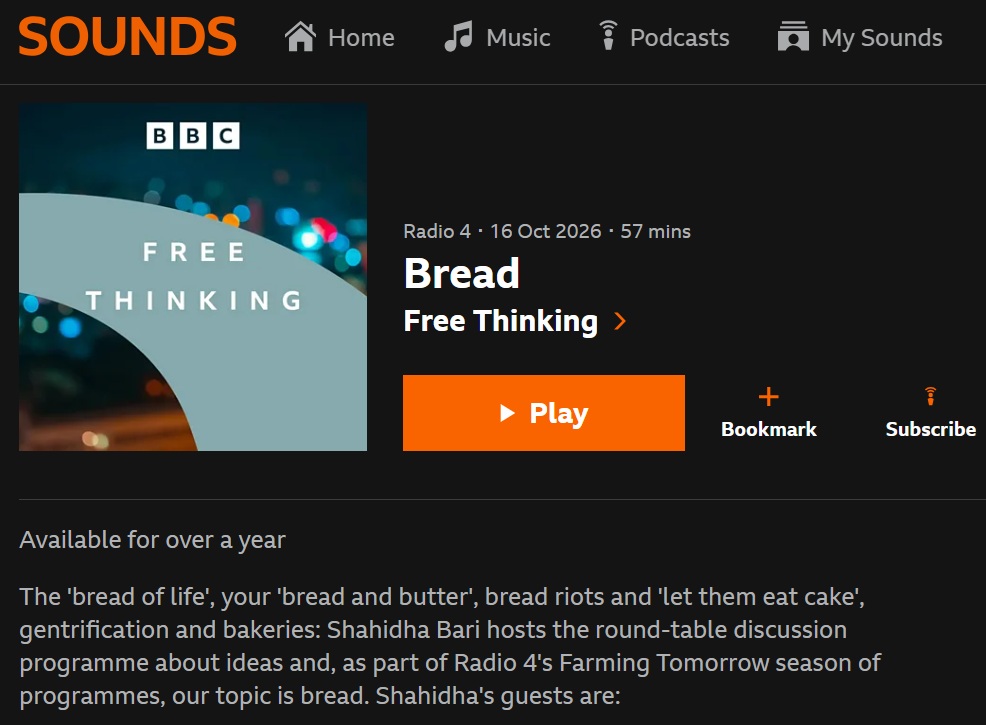
Click here to listen: https://www.bbc.co.uk/programmes/m0032rdw
(I have previously appeared on this show discussing humility, Essex, animals and roads – though not yet at the same time).
It’s always a pleasure appearing on Free Thinking, and hence such a shame that the programme will be axed. While the live broadcast format can be a little daunting at first, it forces you to channel nerves and undigested thoughts into live dialogue with those making sense of the same problem.
A live show also forces you to really listen to what others are saying, sometimes to challenge and other times to add or clarify what they are setting out; the earlier, pre-recorded format made it a little safer to glance at notes. I’ve worked with a few hosts and producers and enjoyed it each time. Matthew Sweet would ply guests with wine which added tasty fuel to discussions; on the bread programme, we had a choice of fresh bread, inc. a delicious soda bread made by Pen Vogler (Paul Mason had a hearty appetite).
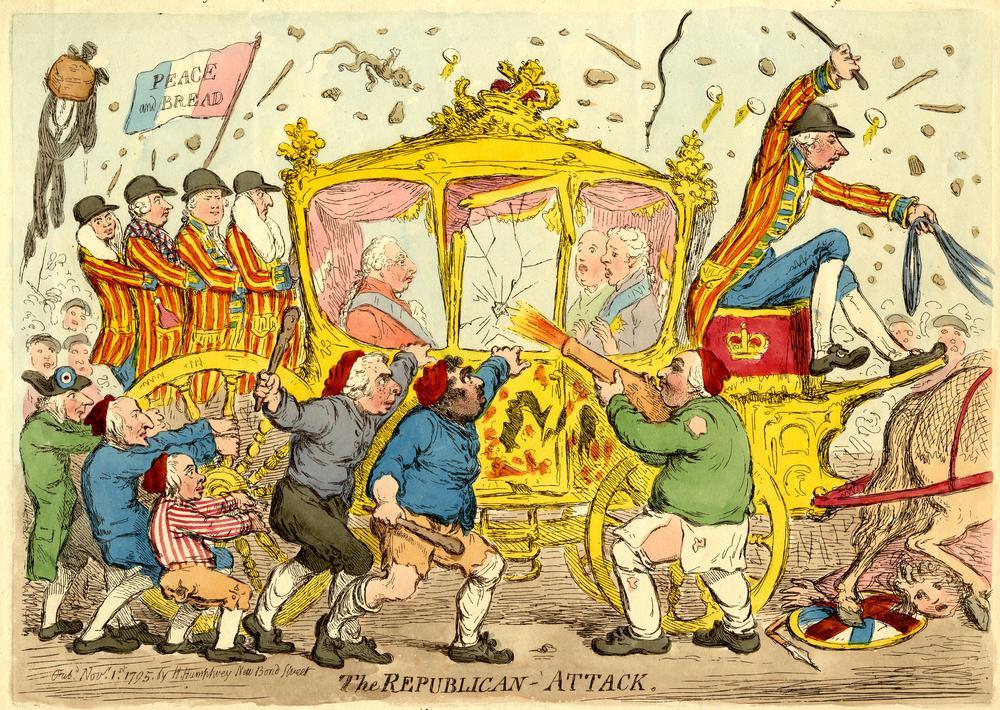
Why bread? Well, it’s the concept binding together the book I’m writing, the bread of life, making sense of years of fieldwork and discussion about politics, community and what we owe each other. It cuts through history, religion, culture, gender and class. There is the everyday bread we eat, and what it says about us; the shared bread of community, connection (com-pany and com-panions are those we share bread with), and its place in religion; and the political bread of hunger riots and bread marches, often led by women, wherein the loaf of bread (on a pitchfork or pole) becomes a claim about justice and rights.
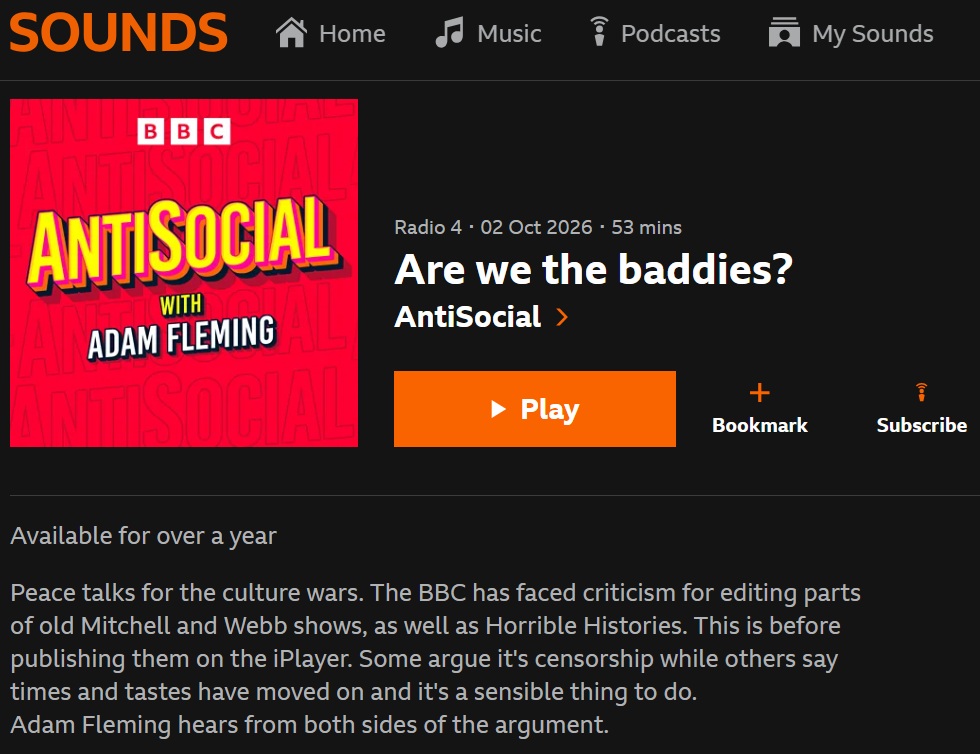
I was also on BBC Radio 4 earlier this month on AntiSocial, discussing free speech and its history, in particular the term bowdlerise. I appear ten minutes before the end, which alarmingly meant that many were subject to my diffident ponderings right before the World at One.
Listen here: https://www.bbc.co.uk/sounds/play/m003246z
In September, I was on a panel for a Carers Trust webinar, ‘Care Pressures rising’, which set out forecasts explaining how the number of unpaid carers was failing to keep up with demand. The number of people with support needs will increase to 9.4 million by 2035 and 10.3 million by 2050, yet the shortfall of available unpaid carers (due to changes in family structure and work) could be around 600k by 2035 or 1.1 million by 2050.
Here’s a link to the findings: https://carers.org/campaigning-for-change/caring-in-2035
And here is a video of the webinar:
These numbers are abstract and difficult to grasp, so it’s worth raising one question: are unpaid carers currently sufficiently supported at a local and national level? The answer is no (with reference to the nationwide closure and cutback of local carers services, alongside ongoing issues in England with Carer’s Allowance). The gloomy forecasts here about a future of higher-intensity, in-poverty caregiving are rooted not in idle demographic speculation but in data about current carers from the last decade.
What to do? While I’m intrigued by talk of a National Care Service, it has always been an ambitious yet imprecise formulation, no clearer than when Burnham first raised it in 2010. Scotland’s example does not bode well. I think it’d be more fruitful to focus on getting the basics right now; establish a minimum income floor for carers; establish a UK nations group to compare carer policies across the nations and establish a minimum offer, focused on the capacity to care and the social risk of caring; and revisit Dilnot specifically on capping the costs of residential care (which would offer much more social protection for families than the mooted NCS).
This would seem more promising than waiting for the outcome of the Casey Commission, already weighed down by expectation, in an election year made fraught by the impacts of inflation, war, climate upheaval and a decade of economic stagnation. I set out some of this thinking here, though it takes up much more space in the book.
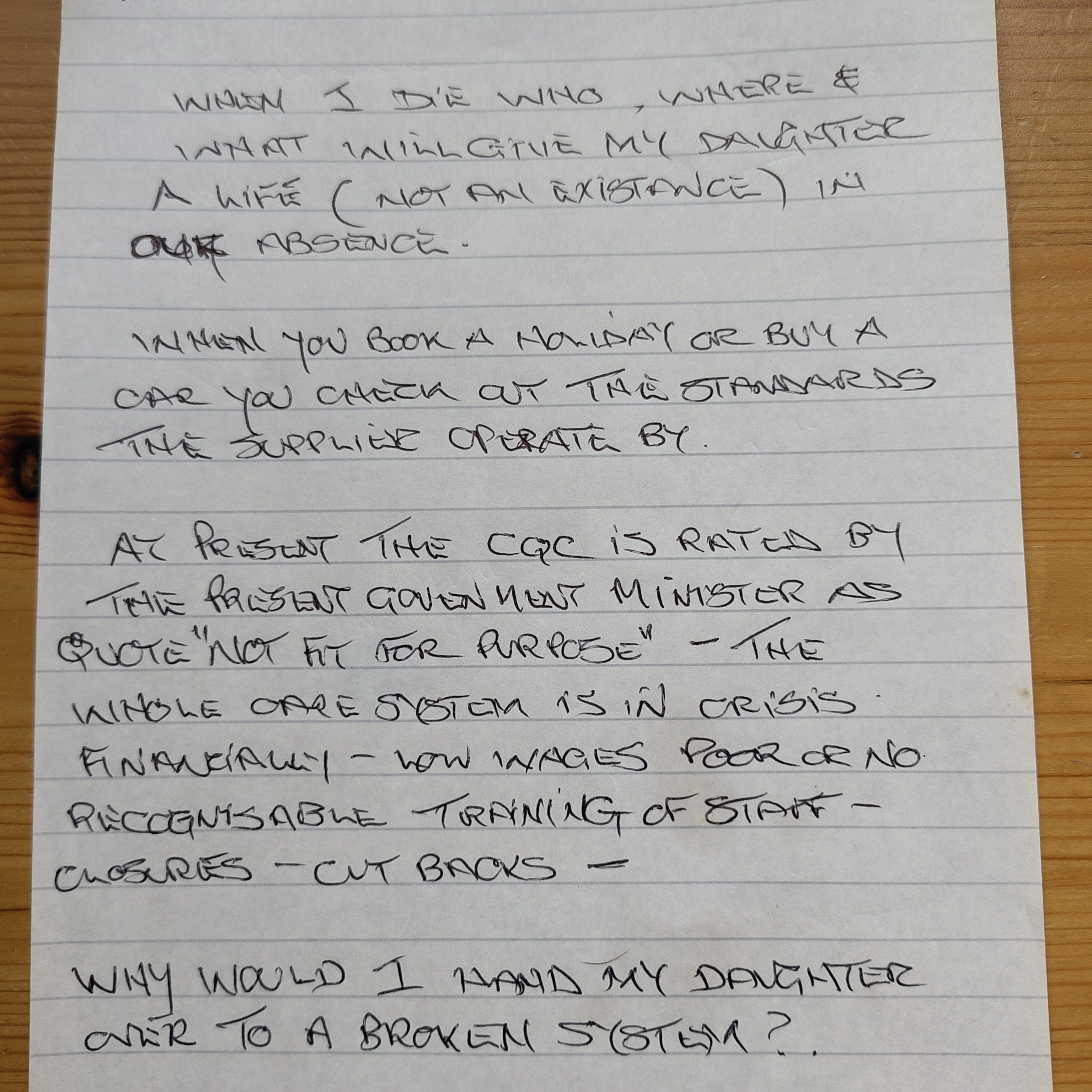
I’ve noted at various points the emotional and political weight of the material. Sometimes it chokes. I’ll share this powerful note, which begins the last section of a part about care, from a caregiver of a disabled adult child. It’s part of a bigger dossier, handed to me over several years, concerned far more with the rights of those with disability than any internal sense of carer rights or entitlement.
I’m trying to make sense of around four years’ caregiver trajectories, picked up through the fieldwork, alongside their place in a history of unionism and social protection. That led me, unexpectedly, to E.P. Thompson, though I’ve also found his account of figures like Thomas Spence, an English radical from the North East who first wrote of the rights of children, irritatingly dismissive. I’ve never worked on a project where the archive is both historical figures and living people. The level of ethical care and responsibility is massive.
So it was in the Fens, and so it is now in Barking and Dagenham, where the community research network I developed and got funded with local residents has now finished collecting evidence. It won’t be until February that the material will be launched, but it’s been a privilege to watch a group of residents from a genuinely wide range of backgrounds and ages come together over months to develop academic-level research about where they live. Today we came up with a term to describe why a place feels uncared for when flytipping and rubbish goes uncollected, and how that leads to a sense of stigma, disconnection, anomie – dumped mattress theory. There are many such gems in this next work.
So this is where I am. Another season.


Leave a Reply